Nothing here makes sense • But everything has an effect • Lado S
Surreal
Corporate events
9 min read
The end-of-year company party
A complete guide for whoever has to organise the company event: deadlines, formats, budget and what to ask before signing for a venue.
The Surreal team
·
August 2026
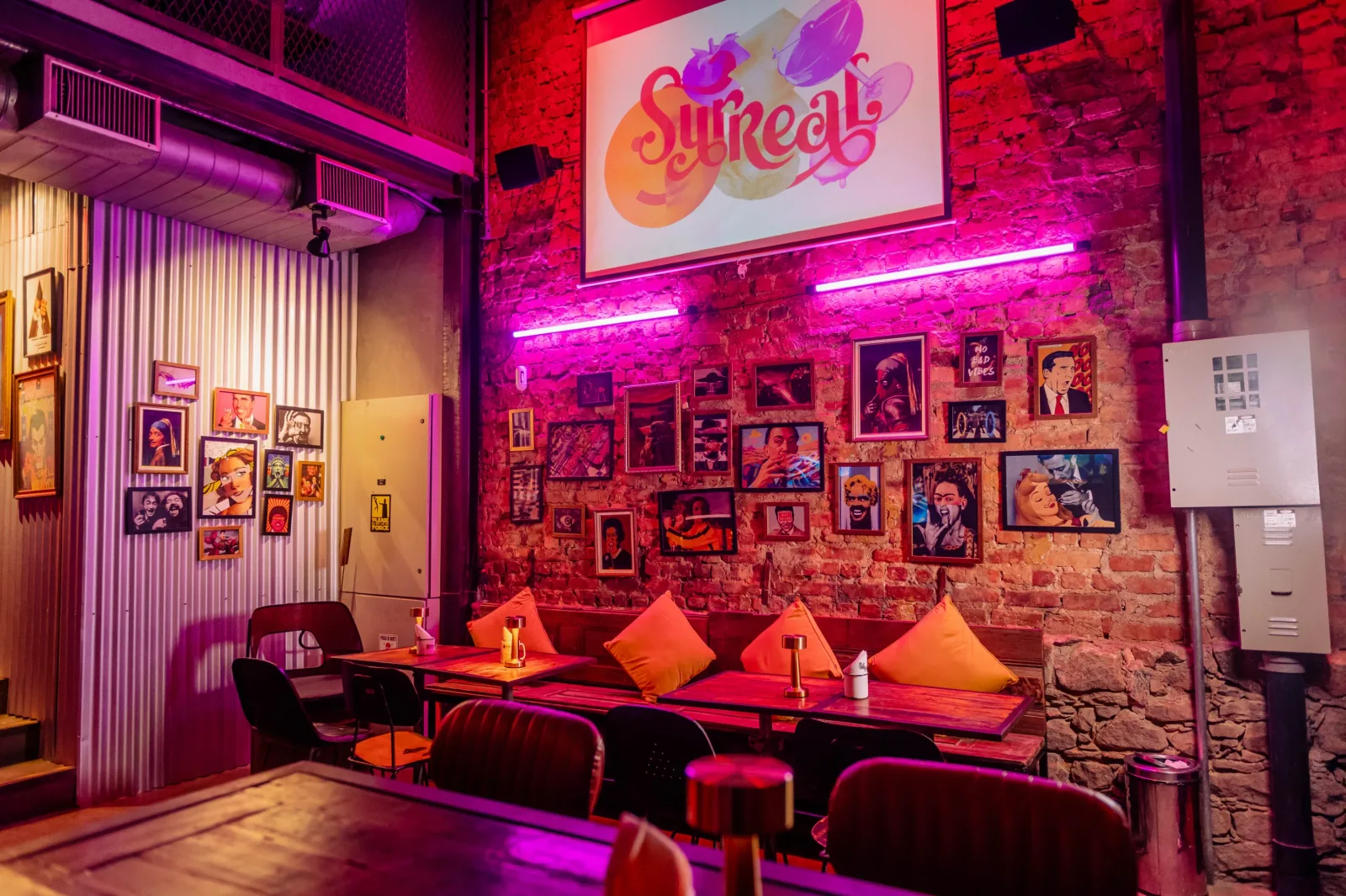
The Surreal dining room, in Botafogo, set up to host groups.
The sequence repeats itself at almost every company. The board approves the idea in September, the budget comes out in October and, by the time it is your turn to book, the Fridays in December are gone. Then the negotiation starts going downhill: the date changes, the format changes, the team's expectations change.
The difference between a night people are still talking about in March and one nobody remembers in January is rarely the amount spent. It is the order in which the decisions were made, and how much you understood about how the venue works before signing anything.
This guide is for the people who actually organise it: the HR team defending the budget, the admin who signs the contract, the manager who wants to thank the team without turning the night into a meeting with food.
The end-of-year party is only one of the formats
December concentrates the demand, but company events happen all year round. Working out which one yours is changes everything, because each one calls for a different configuration of space.
End-of-year party
The classic. The point is to say thank you and to bring people together. It needs a room that loosens people up and as little programming as possible.
Celebrating a target hit
Decided at the last minute. It needs a place that can handle a group quickly, without a long proposal process.
Team or department happy hour
The most frequent and the cheapest format. It works better midweek, when the cost drops and the space is calmer.
Welcoming new hires
It needs a room where you can talk without shouting, because the literal point is for people to get to know each other.
Dinner with clients
Here the space speaks for the company. A generic room says you did not think much about the meeting.
Wrapping up a project
Common in agencies, production companies and consultancies. It usually carries real emotional weight, because the team is moving into a new phase.
Year or quarter kickoff
Better at lunchtime. It combines the institutional part with getting people together, without taking up their evening.
Why September and October decide December
Venues with an identity of their own — the ones people talk about afterwards — work with a limited number of rooms. They are not halls that reconfigure endlessly. Once the Fridays in December are booked, they are booked.
Booking early brings advantages that never show up on a spreadsheet. You choose the date instead of taking what was left, and a good date changes attendance. You understand the service format before deciding, which avoids finding out too late that the model doesn't suit your team. And you gain room to adjust after listening to people, because the first idea is almost never the best one.
Start with two numbers
How many people are likely to come, and what the investment per head can be. With those two figures, the conversation with any venue moves in minutes. Without them, you get generic proposals and spend two weeks comparing things that cannot be compared.
Formats by team size
Ten to twenty people. A single table or two rooms close together, with food to share. Sharing creates movement and natural conversation, which an individual plate does not.
Twenty to fifty. A reserved room with roaming service. It lets people move between groups during the night, which is exactly what a company party should provoke.
Over fifty. Free movement between rooms. A fixed table with a large group creates islands and stops departments from mixing.
Lunch instead of dinner. An underrated option. It costs less, respects anyone with small children or a long commute, and dodges the war over December evening dates. It has been growing, especially among companies with offices in the Zona Sul of Rio.
Food to share creates movement and conversation between departments that never speak.
What to ask before you sign
This list separates a comparable proposal from a confusing one.
01
What is the booking model?
There is an enormous difference between taking the whole house and reserving one room inside a place that stays open to the public. Cost, mood and level of control change completely. Know which of the two you are buying.
02
How long is included?
Almost every package has a defined window, usually four hours. Ask how an extra hour works, because a good party always runs over.
03
Is there a minimum number of people?
This is the figure that most often breaks a budget when it is discovered late. If the minimum is thirty and your team is twenty, you pay for thirty anyway.
04
How is the food served?
Seated menu, stations, buffet or roaming finger food. Each format changes the social dynamic of the night in a way most organisers underestimate.
05
What is included in the drinks and what is an upgrade?
Soft drinks, water and draught beer are usually in the base package. Original cocktails and imported beer are usually extra. Settling this beforehand avoids the surprise bill.
06
Are a DJ and live music included, or booked separately?
And, above all: are they available in the model you chose? Not every booking format can host live sound.
07
How do the deposit, the balance and cancellation work?
High-demand dates require a deposit to hold them, usually half the value. Know the deadline for the balance and what happens if the headcount drops.
08
How long is the proposal valid?
An event quote usually has a short validity, sometimes fifteen days. If it takes you forty days to get internal approval, the prices change.
09
Is there a setup for a speech?
If the event has a presentation, an award or a speech, sort out the microphone, the sound and the projection in the first conversation. Solving it the day before rarely ends well.
The paperwork that blocks things more than the budget
Nobody writes about this, and it is where processes get stuck.
Invoice and legal entity. Confirm before signing. If your finance team requires an invoice with a specific company registration, sort it out in the first conversation.
Payment terms. A mid-sized company pays in thirty days. An event venue works with a deposit up front and the balance before the date. That gap needs to be negotiated in advance, not the day before.
Internal approval in parallel. If the proposal is valid for fifteen days and your board takes twenty to approve it, you will be renegotiating. Start the internal process together with the request for a quote, not after it.
Final headcount. Put in writing the deadline for confirming the number and what happens if attendance comes in below the forecast.
Secret Santa, done so it becomes the best moment
Secret Santa — or whatever it is called where you grew up — is the best-loved and worst-executed tradition of company parties. Done in a rush, it fills drawers with mugs.
With a theme
A book that marked the year, something the person would do if they didn't work here, the most useless item possible. It solves the block for people who don't know what to buy, and it levels the cost.
Experiences
A coffee, a hike, a ticket. It works well in teams that already know each other.
Reverse
Everyone donates to a cause chosen together, and the draw reveals who donated on whose behalf. Large teams take to it with enthusiasm.
With clues
Before revealing the name, the giver offers three characteristics of the person. It stretches the moment out and produces the best laughs of the night.
Three practical points. A spending cap that is realistic for the team's salary range. Participation optional, with nobody having to justify anything. And a defined time, because forty people without a clock will eat two hours of your package, and extra hours are charged.
One detail about the space that almost nobody considers: the game needs a room where everyone can see and hear. In an open, noisy hall, half the group misses the joke.
Five mistakes that ruin a good party
1
Too much programming
Speech, results, awards, raffle, another speech. Concentrate the institutional part in the first twenty minutes and let the rest go. Adults know how to enjoy themselves when the room allows it.
2
A room with no personality
A neutral hall, tables in a row, white light. People sit with the same people they sit with every day and the night ends at 10pm.
3
A fixed table for a large group
It creates islands. If the point is to bring departments together, the format has to force movement.
4
Forgetting the people who don't drink
There is always someone who doesn't drink alcohol, and nobody wants to spend the company night holding a soft drink while everyone else toasts. Ask whether the place has a real alcohol-free list.
5
Bad logistics
A venue far from the office kills attendance and makes people leave early. A nearby metro station and good ride-hailing coverage are worth more than they seem.
Start with the date
A company party is not a cost line. It is the one moment in the year when a company communicates recognition without having to write anything down. Done with care, it keeps the conversation going until March. Done on autopilot, it produces a thank-you post and nothing else.
If you have read this far, the next step is simple: settle on an approximate headcount, choose two or three possible dates, and start asking for proposals now, while there is still a diary to choose from.
Corporate events on the Lado S
Organising your team's end-of-year party?
Talk to our team and get a proposal for your group. Botafogo, two blocks from the metro.
Talk to the team →
Nothing here makes sense. But everything has an effect.
R. Paulo Barreto, 102, Botafogo, Rio de Janeiro / RJ · 22280-010